
Below are answers to some frequently asked questions about the ESC-PG&E Table Agreement. If your question isn’t answered here, please submit it to us using the form at the bottom of this page.
Table of contents
- Layoff protections
- PIO Electric Estimator rights under conversion to DDE
- Path for Gas Estimators wishing to move into electric
- Bidding
- Active medical
- Retro pay
- Training duties for Distribution Operations Engineers
- P cards / meals
- Submit your question on the TA
Layoff protections
Question: Will layoff protections continue under the TA?
Answer: As members review Attachment A of the Table Agreement, which details all agreed changes to Contract language, some members have concluded that Titles that are not included in that Attachment will not be in the future Contract. These members have expressed concern that key protections against layoffs will not continue in the new Contract. However, only Contract sections that were altered by negotiations are included in TA Attachment A. As layoff protections in Titles 27.2 and 22.3 did not change, they were not included in Attachment A. These layoff protections will remain in the future Contract unchanged.
ESC members have robust protections against layoffs caused by contracting, and these protections will continue under the Table Agreement (TA).
Question: What specific layoff protections are included in the TA?
Answer: First, the Contract protects members from layoffs caused by work being contracted out. These protections will continue unchanged under the TA.
“27.2 b) Outside Contractors: The Company may, at its discretion, assign such work to outside contractors provided that such contracting out shall not, within 120 calendar days of the letting of such contract, cause a layoff or demotion in rate of pay by reason thereof of any employee in the bargaining unit who is engaged in the same type of work or activity as that involved in the work which was contracted. The hiring of temporary employees under the Hiring Hall letter agreement (Exhibit C) is considered contracting for purposes of this section.”
For over 50 years, this section has been the protection ESC members have relied on against layoffs due to contracting. The Contract provides many other protections against layoffs as well, such as in 22.3, which states that there must be lack of work in order for there to be reductions:
“22.3 (a) (1) Transfer and Displacement: The employee displaced for lack of work will be placed in the highest classification starting with their own or successively lower classifications in such employee’s line of progression in which the employee with the least Service in such classification has less Service than that of the displacing employee in the displacing employee’s (i) headquarters, or (ii) Division, or (iii) Region, or (iv) within the System, in that order.”
The Contract also provides for:
- Placement into vacancies and previously held positions
- Pay protection when placed into a lower-paid position
- Rehire rights
- Provisions for senior employees to accept severances in lieu of junior employees being laid off.
Question: What happened to the no-layoffs clause in the previous contract?
Answer: The 2022-2025 Contract extension included a special no-layoffs clause that, according to the terms of that extension, expired December 31, 2025. That contract extension was reached in the context of PG&E’s emergence from bankruptcy and the formation of AB 1054’s wildfire fund. The Company needed the wildfire fund in order to attract investment into PG&E so it could continue to exist, and they needed the Union’s cooperation for AB 1054 to be successful. This need created unique leverage that PG&E unions used to achieve a no-layoffs clause for the term of that Contract extension. During the 2025 negotiations, the Unions did not have a comparable leverage point, and though ESC made every effort to extend that clause into the current TA, management would not agree.
Because management would not agree, the Union sponsored legislation (SB 1011) that would require human oversight of AI use in electric utilities. In turn, management did not offer ESC the same contract language on AI as they offered to IBEW—in essence, the right to notice and effects bargaining. However, ESC already has those rights under Federal labor law, and the Union can enforce those rights by making information requests and issuing demands to bargain. The Company is legally obligated to provide information on changes affecting working conditions and to bargain over those changes.
Question: What other protections against layoffs do ESC members have?
Answer: In addition to contractual and legal protections against layoffs, the strongest assurance of employment security is the demand for your labor, which remains high. PG&E is going through a historic increase to its rate base (as much as $85 billion) as the electrification of transportation continues as well as the adding of load from data centers. In fact, PG&E is seeking an agreement to accelerate the hiring of over 167 ESC employees to help accommodate this expansion.
PIO Electric Estimator rights under conversion to DDE
Question: Will current employees in the Electric Estimating line of progression who are moved into the DDE line of progression need an engineering degree to bid or promote?
Answer: No. Under the TA, if you are a current Electric Estimator, Senior Estimator, or ADE, you will not need an engineering degree to bid or promote if and when the TA goes into effect as the ESC Contract. The TA includes provisions that Present Incumbents Only (or PIO status) in the line of progression will not be required to have an engineering degree to bid or promote in the future.
Path for Gas Estimators wishing to move into electric
Question: How will the TA impact Gas Estimators, Sr. Estimators, and ADEs who want to move into Electric Estimating?
Under the existing Contract, if a Gas Estimator wishes to move into Electric, they must bid and accept a routine Estimator position. If they were a Senior at the top step, they will stay at the 12-month step of Senior until they complete the ETP, then advance through the steps for three years before returning to their former step. This equals a $117,000 reduction in base pay over those six years, which is why no one has availed themselves of this Contract provision in at least 15 years. (Update: we were just reminded by a member that one member did move from Gas to Electric according to this provision about 9 years ago. Thank you for the correction!)
Under the Table Agreement, Estimators without engineering degrees can move from the Gas Estimating LOP to the Electric DDE LOP with pay protection by obtaining a California EIT. (Management will attest when Gas Estimators have enough experience to sit for the EIT without an engineering degree.) Prep courses for the Fundamentals of Engineering exam are eligible for tuition reimbursement from the Company.
For estimators who want to pursue an engineering degree, the TA provides tuition reimbursement as well as provisions for additional schedule flexibility to attend classes. For more information, click here to see the terms of conversion from gas to electric in TA Attachment D.
Once members obtain an EIT (within the terms of this Contract) or have an appropriate engineering degree, they can take the modules at their leisure and take and pass the DDE test (equivalent to the Senior). Then they will be eligible to bid directly into Electric DDE vacancies. If they are ADEs or passed tests, they will receive pay protection for up to three years. Because of the pay protection provided by the TA, the Union anticipates that there will be members who avail themselves of the opportunity to change their line of progression to Electric DDE.
Bidding
Question: What if I took a bid under the old system? How will the new bidding agreement affect me?
Answer: ESC has confirmed with the Company that the new bidding system will not go into effect until post-bidding, which is expected to happen no earlier than April 2027.
Active medical
Question: Will the increase in employee cost-share of medical premiums eat up half of my GWI?
Answer: No. Under the TA, the share of medical premiums paid by ESC members will increase from 7.5% of premiums to 10% of premiums, effective January 1, 2027. However, this 2.5% is not equivalent to half the GWI, as the total premium cost is a much smaller number than any member’s total wage. For example, an ESC member making the median ESC salary will gain $8,059 in annual wages through the 2027 GWI alone:
- $153,500 * 1.05 (for 2026 GWI) = $161,175 (2026 salary), a gain of $7,675
- $161,175 * 1.05 (for 2027 GWI) = $169,234 (2027 salary), a gain of $8,059
This same member, if they are on the most expensive medical plan, will see an annual increase of $1,079 in pre-tax dollars in 2027 due to the increase from 7.5% to 10% cost-share. We will use the most impactful level of medical premiums:
- 2026 medical premium (Anthem employee+spouse+children): total cost $3,329/month or $39,948/yr
- By growing 2026 by the historical rate of medical inflation (8%), we get an estimated 2027 total cost of $43,144/yr
- 2.5% * $43,144 = $1,079
$1,079 (healthcare increase) is far outweighed by $8,059 GWI for 2027 because we are multiplying the 5% by a much larger number (salary) than we are multiplying the 2.5% (annual medical premium). When taxes are taken into account (as healthcare premiums are deducted before taxes), the estimated impact of the negotiated medical cost-share increase to the most affected members’ paychecks is expected to be less than $70 per month in post-tax dollars.
An important consideration as we go through this analysis is that what we are voting on in the Table Agreement is an increase from 7.5 % to 10% cost-share. From 2022 through 2025, the dollar amount of medical premiums paid by ESC members was frozen due to an agreement in the 2022-2025 Contract extension. That agreement had an expiration date of December 31, 2025. PG&E did not implement a 7.5% cost-share during negotiations in 2026. However, when the parties negotiated a new Contract, the starting point according to the previous Contract was 7.5% medical premium cost share.
Question: What is the impact of the negotiated medical cost-share increase on my GWI?
Answer: The following calculations are to quantify the impact of the increased cost share. These calculations are not meant to be exact. Assumptions used include Federal standard deduction, California standard deduction, 2026 tax brackets for Federal, 2025 tax brackets for California (as 2026 were not available), no SSI max, base pay only, other co-share excluded, 401(k) match 8%, other pre-post tax adjustments excluded, 8% medical cost growth, no California refund in Federal income.
The first study is for a member who is single with the most impactful cost-share – single with children and the Anthem HAP plan.
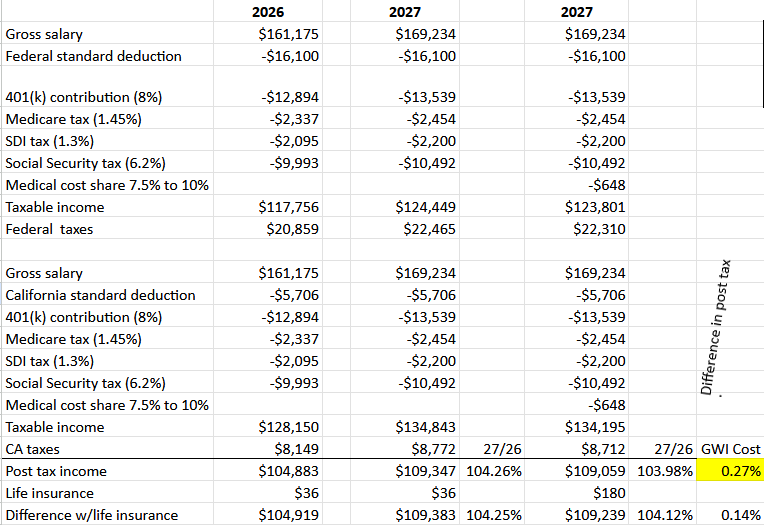
One can see that the increase to post-tax income is reduced by 0.27% by the 2.5% increase in medical cost share. If one factors in the increased value received by going from $10,000 to $50,000 life insurance coverage, the impact is reduced to 0.14% decrease in post-tax income.
The second study is for a member who is married, with children, and on the Anthem HAP plan, which is the most impactful cost-share.
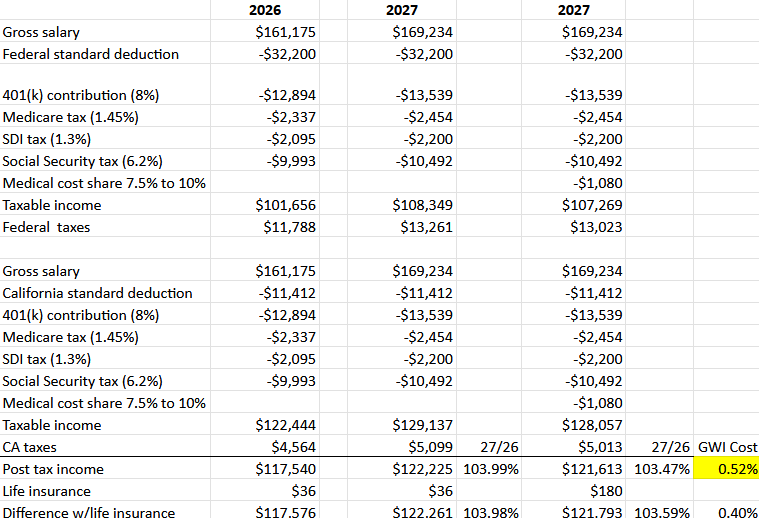
One can see that the increase to post-tax income is reduced by 0.52% by the 2.5% increase in medical cost-share. If one factors in the increased value received by going from $10,000 to $50,000 life insurance coverage, the impact is reduced to 0.40% decrease in post tax income.
The impact is further reduced if the member or member’s spouse earns additional income, because the cost-share is a static number.
In conclusion, there will be reduction in net income caused by going from the frozen cost-share amounts to 7.5% and by the increase from 7.5% to 10% (what we are voting on), but the increase in post-tax income far outweighs the decrease from increased cost-share.
Question: Will medical care like chiropractic or acupuncture services be automatically billed as Out of Network?
Answer: No. If there are no In Network options available within the limits outlined in attachment B, you will not be charged as Out Of Network. The access to chiropractic, acupuncture, and physical therapy remains.

Question: Does the TA provide an incentive for members to opt out of PG&E health coverage?
Answer: Yes, for 2027, PG&E will pay a $3000 a year opt-out payment (paid monthly) to all members who opt out of PG&E health coverage—for instance, because they go on a spouse’s healthcare plan. The Company is offering this as a pilot for 2027 because they want to see if it will save them money. If it does, the Company is likely to continue offering the incentive.
Retro pay
Question: Will retro pay apply to PWI?
Answer: Yes, the retro applies to base salary, PWI’d salary, and overtime since Jan. 1, 2026.
Retro GWI pay back to Jan. 1, 2026, for PWI, OT, and base salary, as well as the $1,500 bonus, is contingent on members voting yes to ratify the TA on the first round of voting. It is not guaranteed to remain if negotiations are reopened.
Training duties for Distribution Operations Engineers
Question: Did higher-level training duties get pushed down into the Journey DOE’s job duties?
Answer: No, management acknowledged that there is an error in Attachment C for the Journey DOE and agreed to remove:
” #1 Assists with developing, updating, and implementing standards, templates, job-aids, training programs and/or procedures for the distribution operations engineering workgroup, or, as requested, helps support similar tasks for other work groups.”, as those duties resides in the Sr. Consulting DOE job description.
Also that it was not the intent of the parties to delete and that they agree to restore to the Senior DOE: “10. As assigned, provide technical training, coaching, and mentoring to other engineers.”
You can see documentation of the corrections to the DOE job descriptions at this link.
P cards / meals
Question: Are P cards being taken away?
Answer: Under the TA, the OT missed meal payment has been increased to $50 and will not require receipts to claim. According to this provision, you will pay out of pocket for your missed meal and receive $50 regardless of the cost of the meal. P cards will still be available, but they will not be used for overtime meals in the future.
Submit your question
If your question isn’t answered here, please use the form below to submit it:
